

Looking back over the spring and summer.
Now we have settled into the winter and head towards Christmas, it is a good time to reflect on the farm’s peak period of activity during the Spring and Summer. For 2025, this period was dominated by drought conditions, which was hugely significant to our workload and yields.
Planting
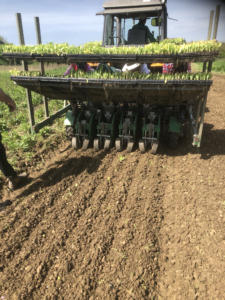
After progressing from seed to plant in the polytunnel, the vast majority of the herbs are planted outside on our Biodynamic farm in Rutland. To plant we have a 4 row tractor-mounted planting machine. We plant very slowly in order to try and achieve maximum root to soil contact. In addition, someone always follows the planter on foot to check that all the herbs are properly in the ground and ready for their new life outside. This is especially important on our undulating terrain. On average we plant about 20,000 to 30,000 a day, depending on conditions, in particular soil moisture. It is hard physical work, but obviously not as hard as it would be without the machine!
Watering
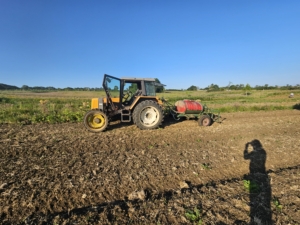
Watering, watering, and more watering has become the overriding memory of Spring and Summer 2025. Once the herbs left the polytunnels for the fields, the battle to keep them alive in the hostile weather conditions commenced. To aid us in this quest, we have a 1000L water tank pulled by a tractor which dribbles water down onto each row of plants. The water is brought up from our bore hole and taken to the field on a trailer which then fills the tractor-powered watering machine. It is slow and laborious work, however we had no choice. To water all the herbs here takes someone all day in the tractor. We were doing this two to three times a week from May to September. We have never had to water on this scale before. In a normal year we are just topping up the water levels during drier spells in the weather.
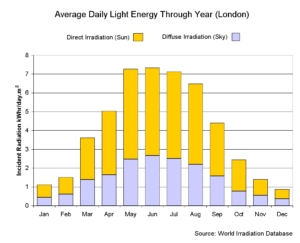
Moreover, the significant lack of rain caused a delay in the planting of our cover crops. This is the sacrificial crop grown between herb harvests, in order to sequester carbon from the atmosphere into the soil, and generally make the soil more healthy and productive. Early planting of this crop allows for enhanced solar radiation capture by the plants, which is crucial for the cover crop to do its job. In short, the more sunlight a cover crop can capture, the more the cover crop will benefit the soil. As autumn progresses, the cover crop’s chance to capture solar radiation reduces drastically as shown in the graph below. Therefore, we are keen to plant early. However, we cannot plant without water in the soil, as without water the seed will not germinate, or worse still, will germinate and then quickly die. The end result for us, was the cover crops being planted later than had been hoped for, which will result in less positive results for the soil. Healthier soil produces more nutrient dense herbs, which in turn makes more effective medicine for your patients. This is why we are so keen to focus on this area.
Harvesting
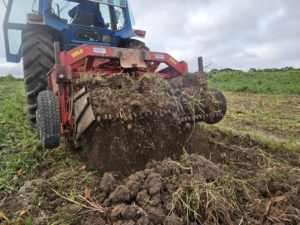
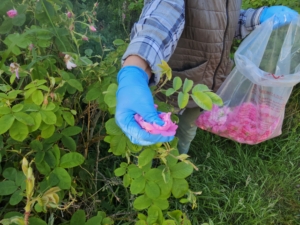
For us, harvesting is almost a year round process, but focuses strongly on the period from May to October. In May we are beginning to harvest Crataegus flowers and Urtica tops. These are harvested from our hedgerows and field corners. Then we move onto herbs like Chamomile and Lavender flowers and other early summer flowering herbs. In the middle summer months herbs such as Hypericum and Melissa become ready. As we progress into August and September we move onto harvesting roots like Taraxicum, Echinacea and Valerian. Our busy harvest period then begins to conclude from September onwards as we look towards the fruits of plants such as Crataegus, Sambucas and Rosa.
Some crops did well in the drought. We had a great year for Withania Somnifera, Chamomile and Taraxicum. Some were not so good. We had poor yields for Echinacea root and harvested only tiny amounts of Hypericum. Normally we grow Echinacea on a two year cycle, however, this year the second year roots came into flower very early which meant we had to harvest the roots early, resulting in very poor yields. Moreover, this dry spring and summer was preceded by an incredibly wet winter which put plants like Hypericum under huge stress leading to tiny yields.
Finally, during the winter we will be looking to start harvesting barks such as Salix, Prunus, Quercus and Vibernum.
Lifting Valeriana Officinalis roots
Harvesting Rosa Damascena petals
And Finally………. We wish you a very Happy Christmas from all at Rutland Biodynamics!
We have a wonderful selection of herbal soaps, perfumes, cosmetics and creams for sale on our website that would make excellent stocking fillers… Click below to shop
Herbal soaps, perfumes, cosmetics and creams – Rutland Biodynamics